
Google Cloud Pub/Sub enables asynchronous communication between services using a publisher-subscriber model. A key decision is selecting the appropriate subscription type: Push or Pull. This choice depends on several factors, including latency requirements, control over processing, and implementation complexity. A logical comparison of these two models helps clarify when each is most suitable.
If you want to learn more, you can check out my GCP Professional Data Engineer course.
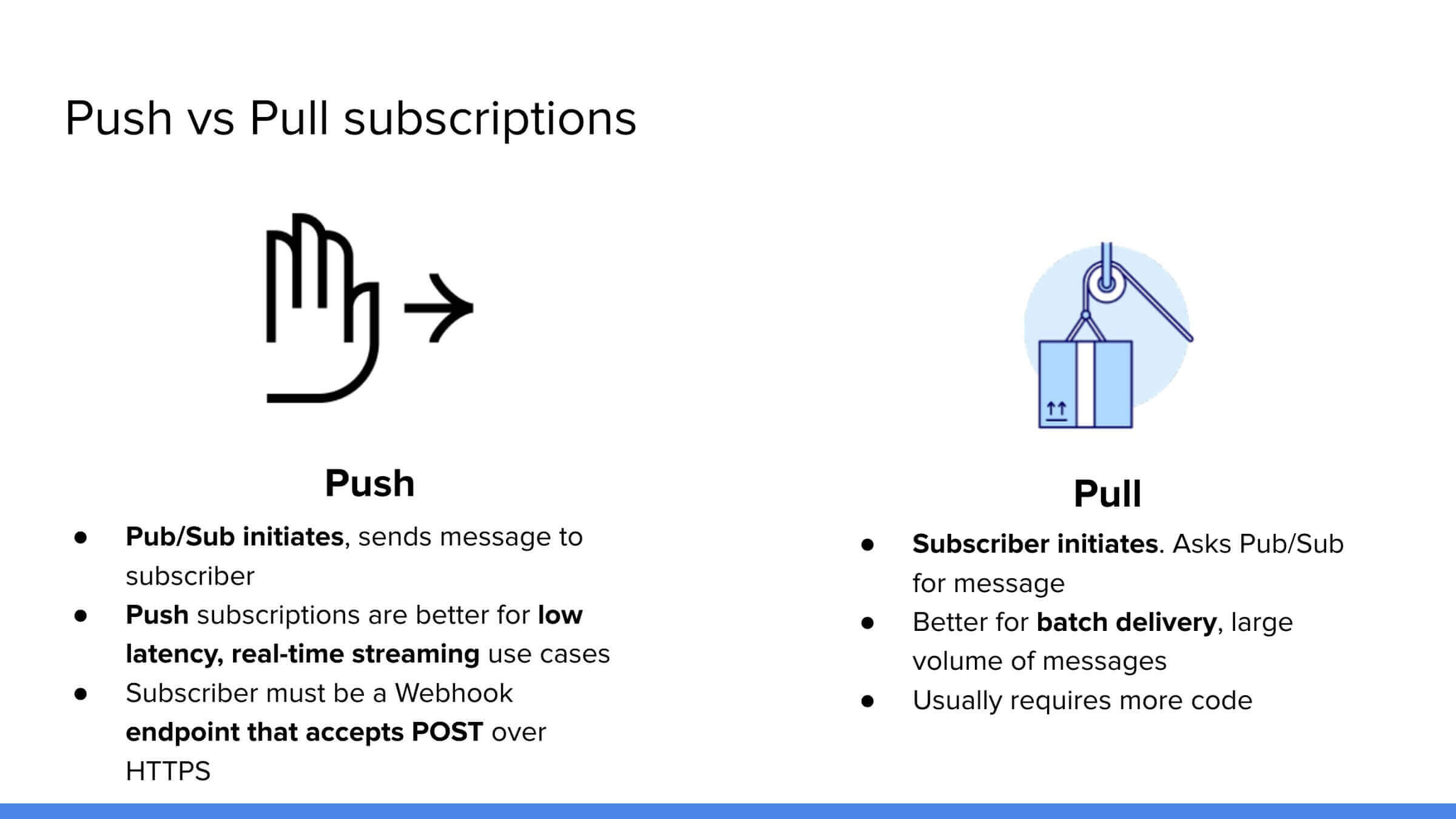
In a Push subscription, the delivery of messages is initiated by the Pub/Sub service. Once a message is published to a topic, Pub/Sub immediately sends it to the subscriber's endpoint without requiring a request from the subscriber. This model is optimized for scenarios that require low-latency delivery, such as real-time analytics, monitoring systems, or alerting mechanisms.
Push subscriptions require the subscriber to expose an HTTPS endpoint that can handle POST requests. The endpoint does not have to be public — Pub/Sub can authenticate to private endpoints using a service account and OIDC tokens, and Cloud Run, Cloud Run Functions, and App Engine integrations are common targets. This simplifies the subscriber code since no polling logic is needed, but it does require a reliable endpoint that can keep up with delivery.
Push subscriptions are therefore most appropriate when:
The application requires immediate message delivery
The subscriber can maintain an HTTPS endpoint that is always available
Minimizing development complexity is preferred
In contrast, Pull subscriptions are initiated by the subscriber. The subscriber application explicitly requests messages from Pub/Sub at a time of its choosing. This approach is particularly beneficial when processing large volumes of data in batches or when delivery timing needs to be tightly controlled by the consuming application.
Pull subscriptions offer greater flexibility but generally require more effort to implement. The subscriber must handle the logic for polling, acknowledging messages, and managing backoff or retry behavior, which as you can imagine, means writing more code. This complexity enables more robust and controlled message processing but increases development overhead.
Pull subscriptions are better suited for scenarios in which:
Large message throughput is expected
Batch processing is more efficient than real-time delivery
The subscriber requires control over the rate and timing of message retrieval
Push and Pull are the two classic subscription types and the ones the Professional Data Engineer exam tests most directly. Pub/Sub now also supports BigQuery subscriptions and Cloud Storage subscriptions, which write messages directly into a BigQuery table or a GCS bucket without requiring you to write any subscriber code. If your end destination is one of those, the direct-write subscription is usually a better fit than wiring up a Pull or Push subscriber yourself.
The decision between Push and Pull should be made based on the requirements of the system. When low-latency, real-time delivery is a priority and the environment supports webhooks, Push is likely the more effective choice. If processing flexibility, batching, or message flow control is more important, then Pull provides the necessary control mechanisms.
Choosing between Push and Pull subscriptions in Pub/Sub is a matter of aligning architectural and operational needs. Push subscriptions emphasize simplicity and speed, while Pull subscriptions offer precision and control. Evaluating the latency expectations, message volume, and system design constraints will guide the selection of the most appropriate subscription model.
These topics and more are covered in my Professional Data Engineer course.



